
1. The AI question nobody is asking
Direct answer: the UK has not abandoned digital ID. It has stepped back from requiring one government credential while continuing to build a national digital-ID system and a future in which right-to-work checks are digital. The policy can reduce document fraud and make public services easier to use. Whether it remains genuinely voluntary depends on equal alternatives, the technical architecture, limits on data linkage, independent testing and enforceable redress.
The strongest case for the system
The government's case deserves to be stated without caricature. Identity checks are already fragmented across departments and private verification services. People repeatedly upload the same passport or utility bill, employers face forged documents, and citizens with straightforward records still spend time proving facts the state already holds. A reusable credential could disclose only the fact required, such as being over 18 or having the right to work, instead of copying an entire identity document into another database.
The March consultation commits in principle to usefulness, inclusion and trust, says the national credential will not be a legal requirement, and retains passport, eVisa and other digital routes for employment checks.(Cabinet Office, 2026) A well-designed version could be more private than today's photocopy-and-email system. Selective disclosure could reduce the information shown to employers and service providers; assisted routes could make verification easier for people who struggle with paper processes; common security standards could raise the floor for private verification companies.
That is the strongest opposing case, and much of it is sound. The dispute is not between modern services and nostalgia for paper. It is about whether the architecture delivers those narrow benefits without creating a reusable population identifier, a cross-service transaction trail or a biometric layer that people cannot meaningfully challenge. Convenience is evidence of utility. It is not evidence of proportionality, non-exclusion or resistance to future expansion.
Every load-bearing decision the proposed digital ID makes is, today, an AI decision.
Face matching is a deep-learning model. So is liveness detection, the check that you are a real person, now, rather than a photo or a video. So is document-tampering detection, fraud scoring and automated revocation. The vendors named or implied in the government's plans, iProov, IDEMIA, Yoti, Onfido (now part of Entrust), all run proprietary deep-learning systems. None of those models is open to public inspection. None is subject to a statutory bias-suspension trigger. None is bound by a primary-legislation prohibition on training-data extraction.
In operational terms, the "Trusted" principle is a claim about the trustworthiness of these AI systems. Right now there is no statutory mechanism that tests it. There are at least six risk dimensions here, and most are absent from the published documents.
The verification layer is itself AI, and its bias is measurable. The vendor that supplies a civilian digital-ID liveness layer often supplies police facial-recognition products too. The bias profile of the model flows straight into every right-to-work, right-to-rent, age-attestation and benefits decision. The UK's own National Physical Laboratory found that the Metropolitan Police's deployed face-recognition system showed no statistically significant demographic bias at the operating threshold the force uses (0.6); statistically significant disparities — more false matches for Black subjects — emerged only at lower thresholds the force says it does not use.(National Physical Laboratory, 2023) Threshold choice is itself a policy lever, and the civilian digital-ID vendors publish no equivalent independent bias data at all. That gap is itself a finding.
Vendors have every incentive to train on the data. Every enrolment hands the vendor a labelled biometric pair, the source document photo and the live capture, annotated with date of birth, nationality, address and, where collected, ethnicity. That is the exact data class that improves face-recognition models. A contractual promise not to reuse it falls short. The prohibition needs to be statutory, criminally enforceable, and extra-territorial, so it follows the data even when processing happens overseas.
Generative AI is already a circumvention vector. The Online Safety Act experience showed that users will deploy AI-generated images and video to defeat age verification. There are documented cases of rendered video-game characters being accepted by verifiers.(PC Gamer, 2025) Liveness detection is now in a direct arms race with diffusion models, and a system whose entire user-facing security claim rests on liveness detection has tied its fate to that race.
Cryptographic privacy alone falls short. Zero-knowledge proofs and differential privacy are necessary, but they are not the whole answer. Machine learning can re-identify supposedly anonymous attribute streams from the metadata around them: timing, device fingerprint, network path, behavioural cadence. Any privacy guarantee has to hold against a machine-learning adversary, not merely a human one.
Models change silently. A face-matching model deployed today is not the model deployed in six months. Vendors retrain. The accuracy and bias profile of one version may be markedly worse than the last for specific groups. There is no published requirement for change-control approval, no pre-deployment review by the National Cyber Security Centre, no disclosure of which model version is live in production. Silent retraining is not compatible with "Trusted."
Stated intent should be taken seriously. Senior figures have been candid about the ambition. In December 2025, the Home Secretary spoke publicly of an "ultimate vision … to achieve, by means of AI and technology, what Jeremy Bentham tried to do with his Panopticon," so that "the eyes of the state can be on you at all times."(UnHerd, 2026) That is a matter of public record. Architecture should assume that intent and constrain it by statute, not by guidance that a future minister can rewrite.
What this means in practice is an "AI floor" written into primary legislation. An absolute prohibition on training any model on UK digital-ID biometric data, anywhere in the world. Mandatory disclosure of training-data composition with demographic breakdowns. An automatic bias-suspension trigger if any group's error rate exceeds twice the baseline in independent testing. Statutory exclusion of generative AI from identity decisions. An "AI-equipped adversary" assumption baked into every privacy guarantee. Model-versioning and change-control with NCSC pre-deployment review. High-risk classification for the biometric layer on the model of the EU AI Act. And whistleblower protection for the engineers who build it. Without that floor, every other safeguard is left to the discretion of the vendors. With it, the public has something it can enforce.
2. What the digital ID U-turn changed and what it did not
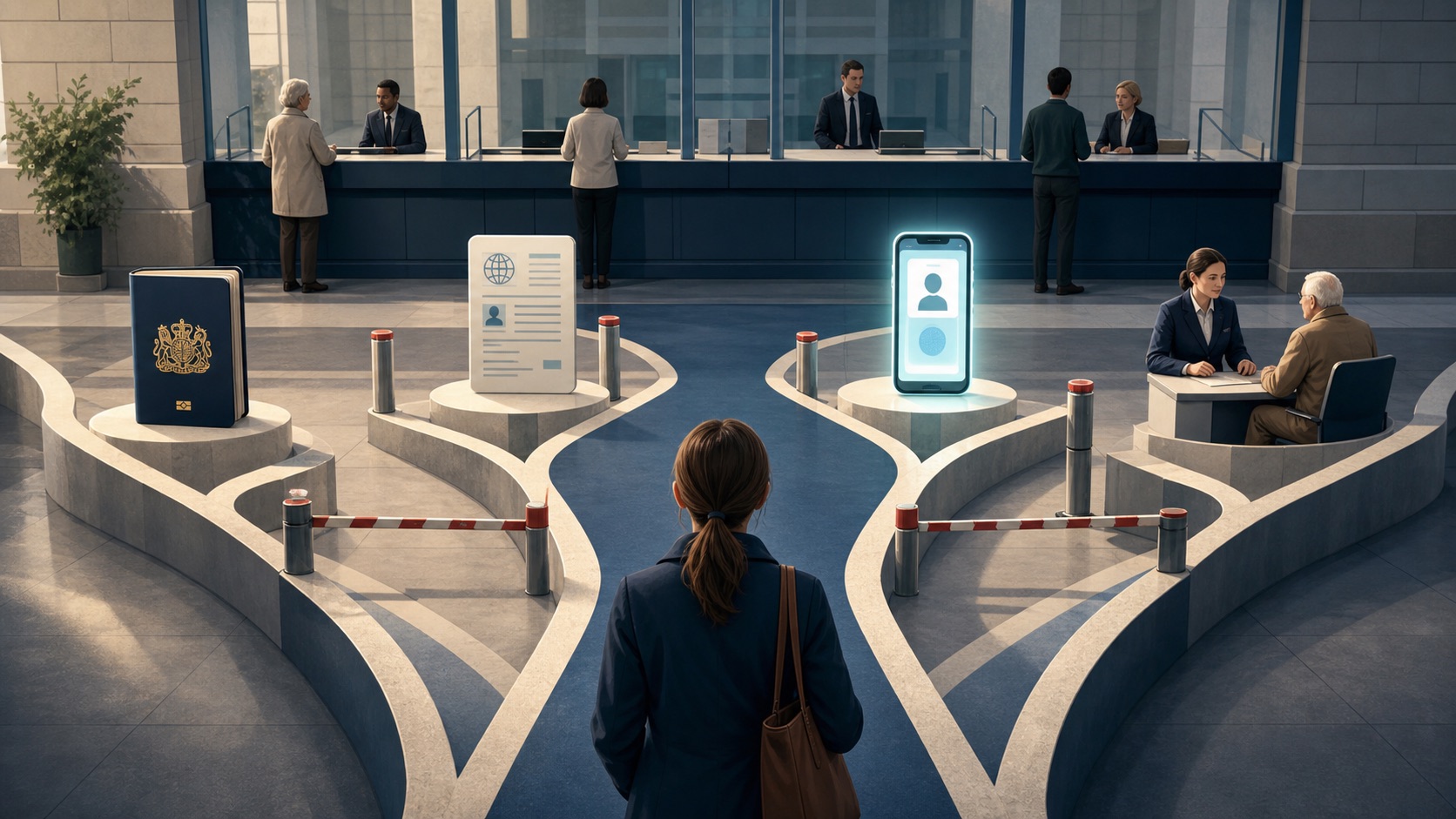
The government did make a real concession. In September 2025 it announced that one government-issued digital ID would become mandatory for proving the right to work. By January 2026 it had abandoned that exclusivity: passports, eVisas and other approved digital evidence would remain valid routes. The Home Affairs Committee later described the change as a move from "mandatory to manageable" and criticised the back-to-front policy process that produced it.(House of Commons Home Affairs Committee, 2026)
The March consultation goes further in its public language. It says there will be no legal obligation to have or present the government digital ID, and describes the credential as something people should want rather than be forced to obtain.(Cabinet Office, 2026) That is a meaningful U-turn from a single compulsory card. It is not the abandonment of digital identity, and it should not be reported as one.
The remaining policy is that right-to-work checks will become digital by the end of the Parliament. An employer may be able to use the government credential, an eVisa, a passport-backed check or a registered verification provider. The distinction is important: one digital ID is no longer mandatory, but a digital checking system still may be. The final supplementary code for digital right-to-work services was published in June and can come into force no earlier than 1 September 2026, once an assessment body is accredited.(Office for Digital Identities and Attributes, 2026) The burden of proof therefore moves from the existence of the card to the quality of the alternatives. Are they legally protected, equally quick, equally cheap and available to someone without a smartphone, conventional documents or a clean biometric match?
The Home Office's 30 June equality assessment confirms that digital checks for British and Irish passport holders already operate alongside manual routes and evaluates the expansion of certified providers.(Home Office, 2026) That is useful baseline evidence, not proof that an exclusively digital future will be non-excluding. The government should publish completion, rejection, correction, cost and assisted-route outcomes by method before removing any existing route.
"Inclusive" cannot survive if the non-government route is technically permitted but slower, more expensive or routinely rejected. The final Bill should create a positive right to a non-degraded alternative and publish rejection, correction and exclusion data by route. Without those safeguards, the U-turn changes the label on compulsion more than its practical effect.
This is not speculative. India's Aadhaar launched in 2009 as a voluntary identity number for welfare delivery. Within a decade it was effectively required for bank accounts, mobile phones, tax filing and a hundred other purposes.(Global Freedom of Expression, Columbia University, 2018) The structural lesson is blunt: "voluntary" status that is not binding in statute and enforced in architecture erodes within about ten years. The fix is small and clean. Convert the rhetorical voluntariness into binding statute, on the model of Australia's Digital ID Act 2024, which gives every citizen a positive legal right to a non-digital alternative with no degraded service.(Australian Government, 2024) Without that, the reassuring language of today is what a hostile barrister will quote on cross-examination in 2032.
3. The convergence problem
The civilian story and the policing story are merging, and the documents say very little about it.
GOV.UK One Login already underpins scores of government services and had been used by over 13 million people by January 2026.(Government Digital Service, 2026) Its biometric layer has had certification and security wobbles, including a government red-team exercise that found contractors could reach its codebase through unsecured workstations.(Computer Weekly, 2025) Separately, policing proposals would extend facial-recognition search access to the passport, DVLA and immigration biometric databases, the same databases that anchor identity. Live facial recognition is being scaled rapidly. A major 2026 expansion added permanent and van-mounted deployments, the Metropolitan Police has scanned well over a million faces, and the first deployment at a protest has already happened.(Biometric Update, 2026)
The civilian digital ID and the police facial-recognition system increasingly share databases, share vendors, and share algorithms. There is no published cumulative impact assessment. There is no statutory firewall.
The question is not whether a police officer can demand to see your digital ID. Officials are right that they cannot. The question is whether the state can search the biometric reference databases that anchor it. On the current trajectory, the answer is drifting towards yes. The fix is structural: prohibit, by primary statute, the use of digital-ID biometric databases or transaction logs for facial-recognition search, predictive policing or general intelligence, with any law-enforcement access requiring an individual judicial warrant on a per-query basis.
4. Architecture is the fork in the road
Strip away everything else and one decision dominates the rest. Is the digital ID a centralised population register, with a universal unique identifier and cross-service transaction linkage, or a decentralised, user-held credential with selective disclosure and zero-knowledge proofs?
Estonia, the EU's eIDAS 2.0 wallet, and Australia's 2024 Act all show that decentralised, user-held, selectively-disclosing architecture is viable at population scale.(European Commission, 2026) (Australian Government, 2024) India's Aadhaar shows the centralised alternative, along with the function-creep, exclusion and mass-breach record that comes with it.(Global Freedom of Expression, Columbia University, 2018) The published UK plans gesture at both and commit to neither. But a "universal unique identifier … to enable consistent reference across government services" is the technical core of a centralised register, whatever the accompanying assurance that "data stays in departments."(Computer Weekly, 2026)
A digital ID with no universal identifier and genuine selective disclosure is the Estonia-class system. A digital ID with a universal identifier and cross-service linkage is the Aadhaar-class system. The choice is not between modern and old-fashioned. It is between two different futures.
None of the privacy-preserving machinery is hypothetical. W3C Verifiable Credentials, Decentralised Identifiers, SD-JWT for selective disclosure, BBS+ signatures for unlinkability between presentations, on-device biometric matching, hardware-backed key storage and a statutory ban on key escrow are the international standard.(W3C, 2025) The UK has no technical reason to deviate from it, only, perhaps, an institutional preference for the version that sees more.
5. What would actually fix it
The remedies are small, specific statutory changes, not a rejection of digital identity as such. Twelve commitments, in primary legislation, would convert the proposed system from a surveillance asset under civilian branding into a privacy-preserving public utility:
- Statutory non-mandation — a positive right to non-digital alternatives, on the Australian model.
- A statutory firewall against facial-recognition access to the biometric databases, except by individual judicial warrant.
- Decentralised architecture by design — W3C Verifiable Credentials, DIDs, SD-JWT, BBS+ unlinkability; no central population register; no universal unique identifier.
- Statutory purpose limitation — purposes fixed in primary statute; new purposes require fresh primary legislation.
- Right-to-work redesign — a binary, zero-knowledge "yes/no" attestation only, with no identity, biometric or status disclosure to the employer.
- Children: strict, separate safeguards — no general-purpose ID for the youngest users; sandboxed, education-only credentials where any are issued.
- An independent statutory Digital Identity Commissioner — with budget independence, pre-authorisation power and standing to seek injunctions.
- Mandatory privacy-by-design technical controls — selective disclosure, hardware-backed keys, no central query log, end-to-end encryption with forward secrecy, a ban on key escrow.
- A statutory redress framework — the right to know who checked what; compensation for wrongful exclusion; fast correction and deletion timelines; an exclusionary rule for unlawfully obtained data.
- A five-year sunset clause — affirmative parliamentary renewal on the basis of an independent published review.
- AI as infrastructure, not afterthought — the full "AI floor" above, in statute.
- Statutory revocation due process — primary-legislation grounds, judicial pre-authorisation, notice with reasons, and a suspensive right of appeal. No civil death by algorithm.
6. What happens next and what to watch
The open consultation closed on 5 May and the People's Panel process was scheduled to conclude on 21 June. As of 24 July, the formal government response and final design remain the next controlling records. When legislation or a final implementation plan arrives, the test is the text, not the press release. Three questions cut through the branding:
- Is there a universal unique identifier? If yes, you are looking at a centralised register, whatever the accompanying language says.
- Is the non-digital alternative a statutory right, or a temporary courtesy? Only the former survives contact with a future government in a hurry.
- Where are the AI controls? If the Bill is silent on training data, bias suspension, model versioning and the police-FR firewall, then "Trusted" stays a marketing claim.
The deeper point is constitutional. AI-driven identity infrastructure, deployed at population scale, without primary-legislation safeguards on training data, bias suspension, model versioning and database convergence, is not a system Parliament can credibly say it has authorised. That choice belongs to Parliament, with its eyes open, rather than to a procurement decision or a vendor roadmap. The work needed is small and well understood. The window is now.
In the meantime, the sensible individual move is the same as ever: reduce the metadata you give away by default. Use end-to-end encrypted messaging, and a VPN you can actually verify, one with an independently audited no-logs policy and a jurisdiction outside the worst data-retention regimes, so your network metadata is not a free gift to whatever the identity layer eventually becomes. For what it is worth, the provider that scores highest on exactly those criteria in our own evidence matrix is also one we partner with (Proton, Swiss, independently audited). We disclose that openly. Our rankings are formula-driven from graded evidence and never move for commission. The methodology is public, so go and check it.
This is the public analysis edition. Our full evidence base, the catalogued claims, primary sources and confidence ratings behind this piece, sits behind the methodology. We earn commission on some links. Rankings are formula-driven from graded evidence and are never influenced by commission. See our Methodology and Disclosure pages.
Related analysis: our VPN-ban investigation tests the same proportionality problem in online-safety enforcement; the verification-state analysis maps the wider European trend; and the VPN ownership map shows why the entity operating a privacy service matters as much as its branding.
7. Frequently asked questions
Is UK digital ID still mandatory?
No single government digital ID is mandatory. The government says there will be no legal obligation to hold or present its credential. It still intends right-to-work checks to become digital through the government credential, an eVisa, a passport-backed route or an approved verification provider.
Will UK employers require digital right-to-work checks?
The government intends digital right-to-work checks to become the required route for new workers by the end of the Parliament. The final implementation, transition period, assisted routes and statutory alternatives remain subject to the formal response and future legal instruments.
Can UK police demand to see a digital ID?
The current proposal gives police no new power to demand the national digital ID during ordinary encounters. A separate concern is whether biometric reference databases or transaction records could be accessed under other legal powers.
Can a digital ID protect privacy?
Yes, if it uses selective disclosure, on-device credentials, unlinkable presentations and a protected non-digital alternative. A universal identifier, central transaction log or reusable biometric database would create a different and greater risk.
8. References
References
- [1]Australian Government (2024) 'Digital ID Act 2024', legislation.gov.au. Available at: https://www.legislation.gov.au/C2024A00025/latest/text (Accessed: 13 June 2026).
- [2]Biometric Update (2026) 'UK watchdog warns of legal risks as London police deploy LFR at protest', biometricupdate.com. Available at: https://www.biometricupdate.com/202605/uk-watchdog-warns-of-legal-risks-as-london-police-deploy-lfr-at-protest (Accessed: 14 June 2026).
- [3]Cabinet Office (2026) 'Making public services work for you with your digital identity', GOV.UK consultation. Available at: https://www.gov.uk/government/consultations/making-public-services-work-for-you-with-your-digital-identity (Accessed: 24 July 2026).
- [4]Computer Weekly (2025) 'Security tests reveal serious vulnerability in government's One Login digital ID system', computerweekly.com. Available at: https://www.computerweekly.com/news/366623991/Security-tests-reveal-serious-vulnerability-in-governments-One-Login-digital-ID-system (Accessed: 14 June 2026).
- [5]Computer Weekly (2026) 'Whitehall launches digital ID consultation', computerweekly.com. Available at: https://www.computerweekly.com/news/366639956/Whitehall-launches-digital-ID-consultation (Accessed: 14 June 2026).
- [6]European Commission (2026) 'eIDAS 2.0 / European Digital Identity Wallet', digital-strategy.ec.europa.eu. Available at: https://digital-strategy.ec.europa.eu/en/policies/eudi-wallet-implementation (Accessed: 13 June 2026).
- [7]Full Fact (2026) 'Government tracker: digital ID', fullfact.org. Available at: https://fullfact.org/government-tracker/digital-id/ (Accessed: 13 June 2026).
- [8]Global Freedom of Expression, Columbia University (2018) 'K.S. Puttaswamy v. Union of India — case note on Aadhaar function creep', globalfreedomofexpression.columbia.edu. Available at: https://globalfreedomofexpression.columbia.edu/cases/k-s-puttaswamy-v-union-of-india/ (Accessed: 13 June 2026).
- [9]GOV.UK (2026) 'Digital ID scheme explainer', gov.uk. Available at: https://www.gov.uk/government/publications/digital-id-scheme-explainer/digital-id-scheme-explainer (Accessed: 13 June 2026).
- [10]Government Digital Service (2026) 'Our roadmap for modern digital government', gds.blog.gov.uk. Available at: https://gds.blog.gov.uk/2026/01/20/our-roadmap-for-modern-digital-government/ (Accessed: 14 June 2026).
- [11]Home Office (2026) 'Digital right to work and rent checks: equality impact assessment', GOV.UK. Available at: https://www.gov.uk/government/publications/digital-right-to-work-and-rent-checks-for-british-and-irish-citizens-equality-impact-assessment-30-june-2026 (Accessed: 24 July 2026).
- [12]House of Commons Home Affairs Committee (2026) 'Mandatory to manageable: the government's plans for digital ID', UK Parliament. Available at: https://publications.parliament.uk/pa/cm5901/cmselect/cmhaff/986/report.html (Accessed: 19 July 2026).
- [13]Institute for Government (2026) 'The government's consultation on digital ID', instituteforgovernment.org.uk. Available at: https://www.instituteforgovernment.org.uk/comment/governments-consultation-digital-id (Accessed: 13 June 2026).
- [14]National Physical Laboratory (2023) 'Facial Recognition Technology in Law Enforcement: Equitability Study (NPL Report MS 43)', science.police.uk. Available at: https://science.police.uk/site/assets/files/3396/frt-equitability-study_mar2023.pdf (Accessed: 14 June 2026).
- [15]Office for Digital Identities and Attributes (2026) 'Supplementary code for digital right to work checks (1.0)', GOV.UK. Available at: https://www.gov.uk/government/publications/supplementary-code-for-digital-right-to-work-checks-1-0 (Accessed: 24 July 2026).
- [16]PC Gamer (2025) 'Brits can get around Discord's age verification thanks to Death Stranding's photo mode, bypassing the measure introduced with the UK's Online Safety Act', pcgamer.com. Available at: https://www.pcgamer.com/hardware/brits-can-get-around-discords-age-verification-thanks-to-death-strandings-photo-mode-bypassing-the-measure-introduced-with-the-uks-online-safety-act-we-tried-it-and-it-works-thanks-kojima/ (Accessed: 14 June 2026).
- [17]UK Parliament, House of Commons Library (2026) 'Digital ID in the UK (research briefing CBP-10369)', commonslibrary.parliament.uk. Available at: https://commonslibrary.parliament.uk/research-briefings/cbp-10369/ (Accessed: 13 June 2026).
- [18]UnHerd (2026) 'Shabana Mahmood's panopticon won't reduce crime', unherd.com. Available at: https://unherd.com/newsroom/shabana-mahmoods-panopticon-wont-reduce-crime/ (Accessed: 14 June 2026).
- [19]W3C (2025) 'Verifiable Credentials Data Model 2.0', w3.org. Available at: https://www.w3.org/TR/vc-data-model-2.0/ (Accessed: 13 June 2026).